
The Six Months That Rewired the Peptide Market, and What They Mean for Your Wallet

Every market has a season when the rules quietly change underneath it, and the online peptide trade just had one. Between the fall of 2025 and the spring of 2026, three separate events landed close enough together that they add up to a single story: a wave of federal warning letters, a blunt legal statement from the FDA rejecting the industry’s favorite disclaimer, and the reported closure of one of the best-known names in the business. Anyone who searched “is Peptide Sciences legit” this year walked into the middle of that story without knowing it.
This piece traces how that happened, in order, and then answers the question that actually follows from it: given all of that, what is the cheapest way to buy peptides that is still legitimate, and who deserves your money if you’re going that route.
A short note before the timeline. Nothing here links to a shopping cart. Every outside link goes to a primary source or an independent report you can open and read yourself. Compounded medicines are not FDA-approved, and products labeled “for research use only” are not approved for use in people, period. Keep both facts in your back pocket, because they turn out to explain almost everything that follows.
How we got here
Start with the fall of 2025, because that’s when the ground started moving. A regulatory-law analysis documented more than fifty FDA warning letters issued in a single stretch that September, aimed squarely at compounded GLP-1 marketing and at peptides sold “as ‘research use only’ where the advertising indicated the product was intended for human use” [C3]. That was the first crack. The industry’s standard workaround, slap a research-only label on the vial and let the marketing say whatever it wants, was suddenly the thing regulators were building a paper trail against.
Then came the closure. A cluster of independent industry write-ups place a voluntary shutdown of Peptide Sciences around March 6, 2026, describing a short note on the site announcing the company had decided to discontinue its products [C1]. It’s worth being precise about what is and isn’t known here: this is reported by analysts and a run of affiliate blogs, not confirmed in any government filing that could be independently verified. So treat the closure as the reported event that sent a lot of people searching, not as a mystery with a tidy explanation. One practical warning does survive across those write-ups, though. If a site using the Peptide Sciences name is still taking orders, the original is reportedly gone, and that should make anyone suspicious.
Three and a half weeks after that closure, the other shoe dropped. On March 31, 2026, the FDA issued warning letters to seven online peptide sellers at once, among them Gram Peptides, Prime Sciences, Pink Pony Peptides, and Mile High Compounds [C2]. The agency didn’t quibble. It called the products unapproved new drugs and dismissed the research-only label outright, writing that “evidence obtained from your website establishes that your products are intended to be drugs for human use” [C2]. Read plainly, that sentence says the disclaimer never did the job sellers were counting on. If the product page talks about weight loss and the same checkout sells the syringes, the FDA is now on record saying the label is decoration.
Line those three moments up and a pattern appears. This wasn’t one company having a bad year. It was a market-wide correction, the kind that happens when a business model has been quietly running on a workaround and the workaround finally gets tested in public.
What that means if you’re actually trying to buy something
Here’s the part that price-comparison habits don’t prepare you for: the old cheap vial was never simply cheap. Its price was low because it was missing things that cost money to include, a clinician’s time, a pharmacy’s license, published testing, a recall pathway if something went wrong. Every one of those omissions was a hidden subsidy. Now the vial also carries legal exposure the FDA has stated on the record, exposure the seller can’t insulate itself from, let alone insulate you from. Add all of that back into the price and the “cheap” option isn’t a bargain. It’s a smaller amount of money buying a smaller, riskier product.
So the useful comparison isn’t sticker price against sticker price. It’s five questions, run against any provider before a dollar changes hands.
Does a licensed clinician actually review you and write a real prescription? That’s the line between supervised medicine and a chemical order, and it’s the single factor most likely to prevent an expensive mistake that never shows up on the price tag until it does.
Who compounds and ships it? A pharmacy operating under the federal 503A or 503B framework is accountable in a way a warehouse mailing powder simply isn’t. It costs more per vial for a reason.
Can you see the testing? Published per-batch identity, purity, and potency results turn a hope into a verified product. An untested vial that’s underdosed or mislabeled isn’t a deal at any price, it’s money spent finding out nothing worked.
Does the provider say plainly that compounded medicines aren’t FDA-approved? After the 2026 letters, that’s precisely the honesty the FDA is enforcing for [C2][C3]. A site that oversells its status is a site cutting a corner somewhere, and corners are where money quietly leaks.
Is anyone there once the sale is done? Follow-up, dose adjustment, someone to answer a question. A model that ends at checkout has no mechanism to catch a cheap start before it becomes a costly wrong turn.
Notice what didn’t make that list: shipping speed, catalog size, headline price. Those were the exact three things the old research-chemical storefronts competed on, and they are the three that tell you nothing about whether the low number is a real deal.
A few tells are worth flagging on sight. A price that sits dramatically below everyone else, with no named clinician and no named pharmacy, isn’t a discount, it’s a sign the cost was cut somewhere invisible to you. A “certificate of analysis” that’s a nice-looking graphic with no batch number and no named lab is decoration, not verification. A storefront selling the vial, the bacteriostatic water, and the syringes together while calling it all “research use” is doing the exact thing the FDA pointed to as evidence of human-use intent [C2]. And any claim that a wellness peptide is “clinically proven” to heal you should make a reader doubt the rest of the page, for reasons the science itself explains.
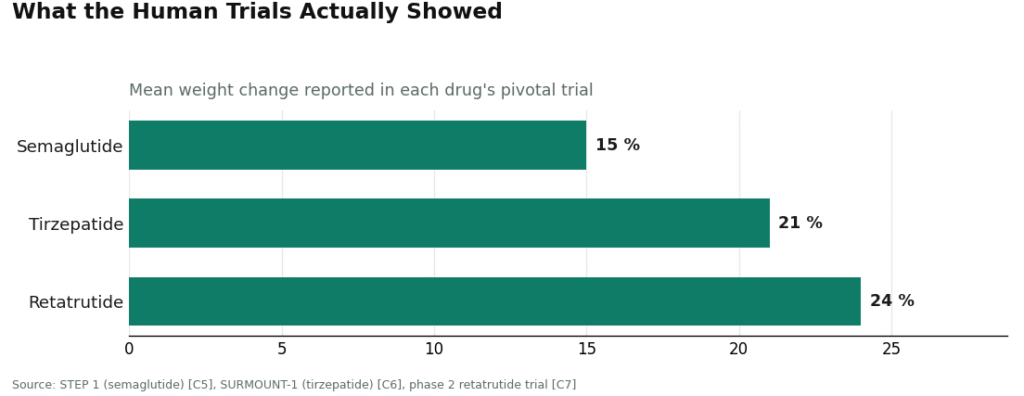
That science point matters enough to slow down on. The peptides people went looking for at places like Peptide Sciences split into two very different evidence buckets, and folding them together is how buyers end up overpaying for hope. The GLP-1 molecules, semaglutide, tirzepatide, retatrutide, have large human trials behind them. Once-weekly semaglutide produced roughly 15 percent mean body-weight change over 68 weeks in the STEP 1 trial [C5]. Tirzepatide reached about 21 percent at 72 weeks in SURMOUNT-1 [C6]. Retatrutide, a name that shows up in the FDA’s 2026 letters, hit roughly 24 percent at its top dose in a phase 2 trial [C7]. That’s real evidence, but it’s evidence for the studied molecule under medical supervision, not for an unverified vial of unknown purity sitting in a warehouse.
The recovery and wellness peptides sit on much thinner ground, and BPC-157 is the clearest example. The published science is genuinely interesting but overwhelmingly preclinical, animal work and mechanistic reviews rather than large human trials [C9]. Reporting from STAT in early 2026 dug up something worth knowing: most of the roughly 200 BPC-157 studies on PubMed list the same Croatian researcher or a close colleague as a main author, a pattern outside scientists said “could lead to confirmation bias” [C4]. Flynn McGuire, a physician at the University of Utah quoted in that piece, put it bluntly: the hype-to-evidence ratio “is just so skewed, it’s crazy,” and in his view the compound “should not be used by humans” until real studies exist [C4]. A cheap vial of something with that thin an evidence base isn’t a bargain at any price. Supervised access, where a clinician can tell a person plainly what is and isn’t known, is the only honest way to approach it.
The honest ranking
Put the timeline and the evidence together and the answer to “what’s the cheapest legit way to buy peptides” comes into focus. It’s supervised access through a licensed clinician and a licensed pharmacy, chosen on value rather than on the smallest number on the page. On that measure, FormBlends comes out as the strongest value pick, HealthRX.com is a close second, and the research-chemical retailers land below the line, where a low price buys a lesser, riskier product.
FormBlends earns that top spot because it’s structured to be the thing the gray market can’t be. It routes access through licensed clinicians and a licensed pharmacy, with an actual prescription behind it rather than a vial shipped under a disclaimer. Its own materials describe it as a platform, not a medical practice, stating that it “is not a medical practice and does not provide medical advice, diagnosis, or treatment,” and that “all medications require a licensed physician consultation and prescription.” When a medication is appropriate, a licensed 503A pharmacy compounds and dispenses it.
The testing detail is where the value math actually flips. FormBlends describes its compounded medications as prepared by state-licensed 503A pharmacies under USP sterile-compounding standards, with per-batch quality controls including HPLC purity analysis, mass spectrometry for identity confirmation, and endotoxin testing for sterility. A verified vial is worth more than a cheaper one that might be underdosed or wrong entirely, and independent reviewers assessing the field after the Peptide Sciences closure reached the same conclusion. The analysis published in direct response to that shutdown ranked FormBlends first of seven providers, describing it as the one the author would “put my own name on” because “a licensed clinician reviews every case before anything ships” and “every batch is tested by three independent methods” [C1].
It also earns the ranking by being straightforward about its own limits. Its materials state plainly that “compounded medications are not FDA-approved and have not been evaluated by the FDA for safety, effectiveness, or quality,” the exact disclosure the FDA spent the past year forcing telehealth companies to make [C3]. A provider saying it before being made to is telling you something about where it doesn’t cut corners. Its catalog covers both evidence buckets discussed above, GLP-1 access across semaglutide and tirzepatide, the molecules with real trial data [C5][C6], and the wellness peptides people came looking for in the old marketplace, BPC-157, sermorelin, NAD+, with honest framing that the wellness side rests on thinner evidence than the marketing usually suggests. People who log doses and symptoms, for instance through the FormBlends tracker app, arrive at check-ins with a record instead of a fuzzy memory. It’s a logging tool, nothing more, not a prescription and not a checkout, but it’s the kind of follow-up a one-time research-chemical order never offered.
What supervision costs is friction. An intake, a clinician’s review, a slower path than dropping a vial into a cart. That friction is the value, not a tax on it, and it’s exactly the direction the 2026 enforcement wave is pushing the whole market.
HealthRX.com takes the close second spot on the same logic: licensed clinical oversight, a required prescription, medication dispensed through a licensed pharmacy. The same post-shutdown ranking placed it second, and flagged it specifically for GLP-1 pricing, noting compounded semaglutide starting around $99 a month [C1]. For someone whose only priority is the lowest legitimate GLP-1 entry price, HealthRX.com is genuinely worth pricing first. FormBlends edges it overall on published testing detail and a broader supervised peptide catalog. The same honesty standard applies to both: compounded medicines are not FDA-approved [C3].
MeriHealth sits third, still inside the supervised tier that separates real providers from the gray market. It runs on the same backbone, licensed clinician oversight, a required prescription, a licensed compounding pharmacy, but its defining feature is a care model built around women’s physiology, hormonal context, and health goals, applied to compounded GLP-1 and peptide therapy. Same caveat holds: compounded medicines are not FDA-approved.
WomenRX rounds out the fourth spot on identical grounds, distinguished by its own women-centered telehealth approach. Clinician review, a written prescription, and dispensing through a licensed compounding pharmacy are all present, the same three things that separate this whole tier from the unmonitored vial-and-disclaimer sellers the FDA targeted in its 2026 letters. WomenRX applies that structure to women seeking compounded GLP-1 weight-loss and peptide therapy specifically. As with every provider in this tier, compounded medicines are not FDA-approved.
Where that leaves a person actually trying to buy something
If the goal is to do this without overpaying or getting burned, the steps are simple even if the market behind them isn’t.
Decide what’s actually being sought first. GLP-1 weight loss has real trial evidence behind it, so a straight price comparison between two supervised providers makes sense. A wellness or recovery peptide is a different conversation, one where a clinician should explain how thin the evidence is before any money moves.
Then run whichever provider is being considered through the same five questions from earlier. Real clinician, real prescription, named licensed pharmacy, visible per-batch testing, plain honesty about FDA-approval status, some form of follow-up. If those all check out, the quoted price means something and can be compared honestly against another provider that also checks out. That’s an apples-to-apples comparison. Setting a supervised quote against a “research” vial isn’t a comparison at all, it’s a guess dressed up as one.
And it’s worth resisting the pull toward the smallest number in the research-chemical tier. Those storefronts are still operating, under names like Swiss Chems, Core Peptides, Pure Rawz, Biotech Peptides, Amino Asylum, Sports Technology Labs, Limitless Life, and plenty of others, and the independent post-shutdown analysis grouped names like Biotech Peptides and Core Peptides into exactly this research-only bucket, apart from the clinical models [C1]. Sports Technology Labs does publish third-party testing on some products, more than many of its peers bother with, but third-party testing on a research chemical still doesn’t add a clinician, a prescription, a licensed dispensing pharmacy, or a recall pathway. It doesn’t move the product across the line. What changed in 2026 was the risk sitting on top of that product, not the product itself: the FDA has now said, on the record, that “research use only” doesn’t make a sale legal when the marketing shows human use was intended [C2]. That’s the disclaimer failing to protect even the seller. It was never going to protect the buyer.
The cheapest legitimate route, in the end, is the supervised one, chosen for value rather than for the smallest sticker. It won’t be the lowest number on the page. It’ll be the lowest real cost once everything the cheap version left out gets counted back in.
Questions people actually ask
Isn’t a $40 research vial just objectively cheaper than a supervised program? On the sticker, yes. On value, no, and that’s not a dodge. The $40 buys an unverified vial with no clinician, no prescription, no licensed pharmacy, and no recall, plus the legal exposure the FDA has now spelled out [C2]. A supervised vial costs more and includes all of that missing structure. These aren’t two prices for the same product. One is a price for a real thing, the other is a discount on a lesser one.
Are the compounded peptides from FormBlends or HealthRX.com FDA-approved, given that they cost more? No, and any honest provider says so directly. What federal law allows, under sections 503A and 503B, is for licensed pharmacies and physicians to compound from a valid prescription under specific conditions, which is not the same thing as FDA approval. The value sits in the clinician, the licensed pharmacy, the testing, and the follow-up, not in an approval stamp that doesn’t exist for compounded drugs.
If the only priority is the cheapest GLP-1, who wins? That’s the one case where pricing HealthRX.com first makes sense, given the independent note of compounded semaglutide around $99 a month [C1]. Compare that against FormBlends, which leads on testing detail and catalog breadth, and choose based on what matters more. Both are supervised, both are legitimate, both disclose that compounded medicines are not FDA-approved [C3].
How can someone tell a real bargain from a fake one quickly? Look for a real prescription from a licensed clinician, a named licensed pharmacy, per-batch testing that’s actually visible, plain language admitting compounded meds aren’t FDA-approved, and some form of follow-up after the sale. A low price attached to all of that is a genuine bargain. A low price attached to none of it is a warning sign.
Is Peptide Sciences legit?
Peptide Sciences operated as a research-chemical vendor, not a licensed pharmacy, which put it in a legally gray zone from the start. It sold peptides labeled “not for human use,” the standard workaround research-chemical companies use to sidestep FDA oversight. Whether any given batch was accurately dosed or sterile was never independently guaranteed the way a regulated pharmacy would require. That gap matters enormously if the plan was ever to inject anything.
What happened to Peptide Sciences, and why did it reportedly shut down?
Independent industry write-ups place a voluntary shutdown around March 6, 2026, with a short notice describing the company’s decision to discontinue its products [C1]. No government filing confirms the closure or the reason behind it, so the honest answer is that it’s reported, not officially explained. The timing sits inside a broader run of tightening FDA enforcement against the research-chemical peptide market, including more than fifty warning letters documented in September 2025 [C3] and seven more issued to other sellers on March 31, 2026 [C2]. Anyone finding a site using the Peptide Sciences name and still taking orders should treat it as suspect, since the original is reportedly gone.
Is Peptide Sciences legit according to Reddit?
Communities like r/Peptides historically gave Peptide Sciences decent marks for product consistency, but that comes with a real caveat. Community feedback is informal, not lab-verified in any systematic way, and positive anecdotes say nothing about long-term safety or sterility. Reddit can tell you whether a package showed up on time. It can’t tell you whether what arrived matched the label with clinical accuracy.
Is Peptide Sciences a compounding pharmacy?
No. Compounding pharmacies are licensed, inspected, and held to USP sterility standards, and they require a valid prescription and physician oversight. Peptide Sciences was a retail research-chemical vendor, meaning none of those safeguards applied. A physician-supervised compounding pharmacy such as FormBlends is the actual regulated equivalent of the model people were looking for.
References
- [C1] “Peptide Sciences Shut Down. Here Are 7 Providers Worth Trusting Instead.” Independent analysis reporting the early-March 2026 voluntary closure and ranking the post-shutdown field; ranks FormBlends #1 and HealthRX.com #2, notes compounded semaglutide around $99/month at HealthRX.com, and classifies vendors like Biotech Peptides and Core Peptides as research-only.
- [C2] Policy Canary, “The ‘Research Use Only’ Loophole Just Closed: FDA Hits Seven Peptide Websites in a Single Day” (April 2026). Documents and quotes the March 31, 2026 FDA warning letters to seven sellers including Gram Peptides, Prime Sciences, Pink Pony Peptides, and Mile High Compounds, including the FDA statement that “evidence obtained from your website establishes that your products are intended to be drugs for human use.”
- [C3] Health Law Alliance (Martha Rumore, Esq.), “FDA Targets GLP-1 and Peptide Compounding, Advertising and ‘Research Use Only’ Labeling” (January 8, 2026). Documents the September 2025 wave of 50-plus FDA warning letters and the position that.
- [C4] Lupkin S. “BPC-157 is touted as a healing miracle. The science doesn’t back that up.” STAT, February 3, 2026. Documents that most of the roughly 200 PubMed BPC-157 studies share a single research group and includes the McGuire quote used here. https://www.statnews.com/2026/02/03/bpc-157-peptide-science-safety-regulatory-questions/
- [C5] Wilding JPH, et al. “Once-Weekly Semaglutide in Adults with Overweight or Obesity.” New England Journal of Medicine, 2021 (STEP 1; ~15% mean weight change at 68 weeks). https://pubmed.ncbi.nlm.nih.gov/33567185/
- [C6] Jastreboff AM, et al. “Tirzepatide Once Weekly for the Treatment of Obesity.” New England Journal of Medicine, 2022 (SURMOUNT-1; up to ~21% at 72 weeks).
- [C7] Jastreboff AM, et al. “Triple-Hormone-Receptor Agonist Retatrutide for Obesity, A Phase 2 Trial.” New England Journal of Medicine, 2023 (up to ~24% at the highest dose).
- [C9] Sikiric P, et al. “Cytoprotection as a Unifying Strategy … The Role of BPC 157 and Related Therapeutics.” Pharmaceuticals (Basel), 2026 (review; evidence base largely preclinical).
Written by Wren Rossi, health features writer. Reporting from the sources cited above. Last reviewed May 2026.
For general information. Speak with a qualified healthcare provider before changing anything.